
Retirement, Reimagined: Why More Americans Are Redefining Life After Work
Nearly half of Americans 50 and older expect paid work to be part of retirement, and rising costs explain only part of the reason.
For most of the last century, Americans treated retirement as a finish line. They worked one last shift and never drew another paycheck. Many more older Americans now keep working than a generation ago. In 2025, 19.1% of people 65 and older were working or looking for work, up from 12.9% in 2000, according to the U.S. Bureau of Labor Statistics.
To learn how Americans nearing or living in retirement plan to support themselves, and how much of that plan still involves a paycheck, My Guide to Retirement surveyed 1,000 U.S. adults aged 50 and older. Respondents shared when they expect to stop working and why some never intend to. Many also described quieter costs, from leaner grocery runs to money borrowed with a spouse’s knowledge. For anyone mapping out the next chapter, their answers offer a frank look at how peers are rewriting the plan.
Key Takeaways
- Nearly 9 in 10 Americans 50 and older (88%) believe today’s workers will have to work longer than previous generations did, and 81% say working into retirement is becoming a financial necessity rather than a choice.
- Fewer than 4 in 10 (38%) plan to stop working for pay completely in retirement, while 49% expect paid work to continue. Yet 87% say anyone who has to keep working to afford basic expenses isn’t truly retired.
- Even if they could afford to stop working today, 45% would keep working anyway. Low earners most often keep working to cover basic living expenses (28%), while high earners most often cite a sense of purpose.
- More than half (55%) say their expected retirement money won’t support the lifestyle they want, and middle earners are the least likely to ever fully retire. Among middle-income respondents, 12% say they’ll never stop working for pay, compared with 8% of low earners and 3% of high earners.
- Nearly half (46%) cut back on groceries or basic necessities in the past year because of retirement-related financial pressure, and 30% skipped or delayed medical care because of the cost. Another 8% admit to taking something from a store without paying.
- More than 1 in 4 (27%) followed social media retirement advice in the past two years that cost them money or left them worse off, most often on Facebook (18%) and YouTube (16%). Looking ahead, 62% believe AI could make it harder for workers to stay employed long enough to retire.
Working Longer Is the New Normal
Generations of workers retired on a schedule. They circled an age on the calendar and stepped away when it arrived. Americans in their 50s and 60s now describe a much blurrier line, one they keep redrawing as they pay more for everyday basics and find their savings coming up short.
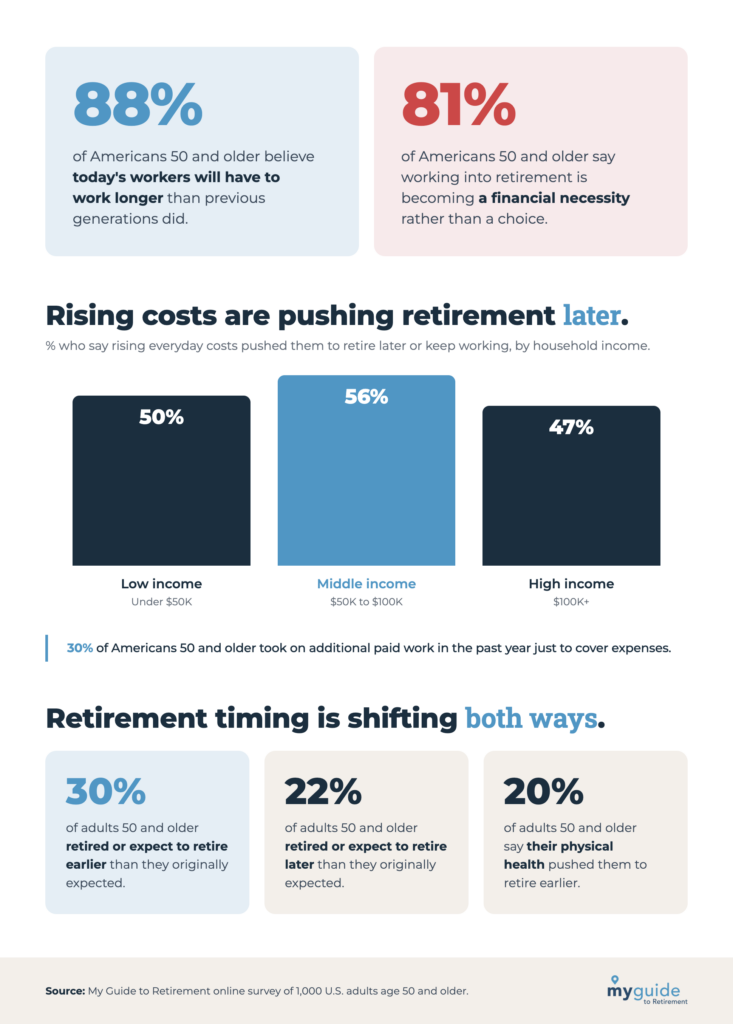
Americans 50 and older have largely abandoned the old model. Among those surveyed, 88% believe today’s workers will have to work longer than previous generations did, and 81% believe working into retirement is becoming a financial necessity rather than a choice. Women hold that view more intensely, with 59% strongly agreeing that today’s workers will have to work longer, compared with 48% of men. Women also report more financial strain throughout the survey, so many may feel the prospect of a longer career more personally.
Respondents have already acted on those beliefs. Among them, 26% now expect to retire later than they originally planned or no longer expect to fully retire, and 30% took on additional paid work in the past year just to cover expenses. Asked what has shaped their timing, 51% say rising costs for everyday basics like groceries and utilities have pushed them to retire later or keep working, a share identical for men and women. Middle earners report that pressure most often (56%), ahead of low earners (50%) and high earners (47%).
A sizable group has moved in the opposite direction, though. Among those surveyed, 30% retired or expect to retire earlier than they originally expected, outpacing the 22% who retired or expect to retire later. Some had no say in the timing, as 20% report that their physical health or ability to keep working pushed them to retire earlier. Anyone planning to work into their 70s needs a backup plan for the years their body may not cooperate, which makes prioritizing health in retirement as much a financial strategy as a personal one.
Half of Americans 50+ Expect to Keep Earning
Ask someone in their 50s or 60s about their retirement plans, and you’ll rarely get a one-line answer anymore. Some people plan to stop cold. Others picture a part-time job or a small business that keeps money coming in, and a few have avoided thinking about it at all. Beneath those plans, Americans hold firm and sometimes conflicting views about what retirement should mean.
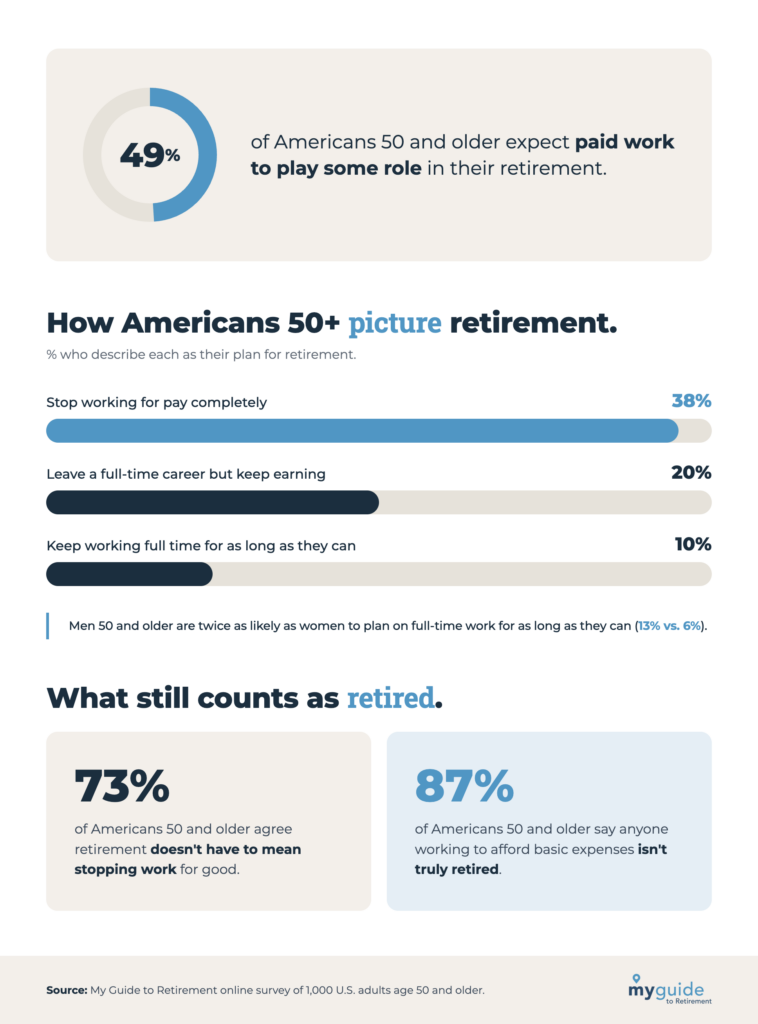
Respondents who plan to stop working entirely are now in the minority. Just 38% expect to stop working for pay completely in retirement, while 49% expect paid work to play some role. For 20%, that means leaving a full-time career but continuing to earn, most often through a part-time job or a side hustle (8% each), and another 10% plan to keep working full-time for as long as they can.
Many still draw a firm line around what counts as retirement, however. Among those surveyed, 73% agree that retirement doesn’t have to mean stopping work for good, yet 87% say anyone who has to keep working to afford basic expenses isn’t truly retired. Respondents appear to judge a working retirement by its motive. Someone who consults for the fun of it is still retired in their eyes, while someone who works a register to cover rent is not.
Men lean harder into the idea of working indefinitely. They’re more likely than women to say paid work will be part of their retirement (53% vs. 45%) and twice as likely to plan on full-time work for as long as they can (13% vs. 6%). Women, however, more often find themselves pushed back to work after they’ve already retired, and they’re nearly twice as likely as men to cite rising costs (12% vs. 6%) or a savings shortfall (10% vs. 5%) as the reason. Women are also more likely than men to say they haven’t thought about their retirement plans at all (11% vs 6%), and 14% of low earners say the same, likely because people stretched by this month’s bills find it hard to plan two decades out.
Two Retirements: One for a Paycheck, One for Purpose
Picture two 66-year-olds clocking in on the same Monday morning. One needs the paycheck to cover rent and groceries. The other has plenty saved and simply can’t imagine a week without somewhere to be. From the outside, the two look identical, yet they work for entirely different reasons.
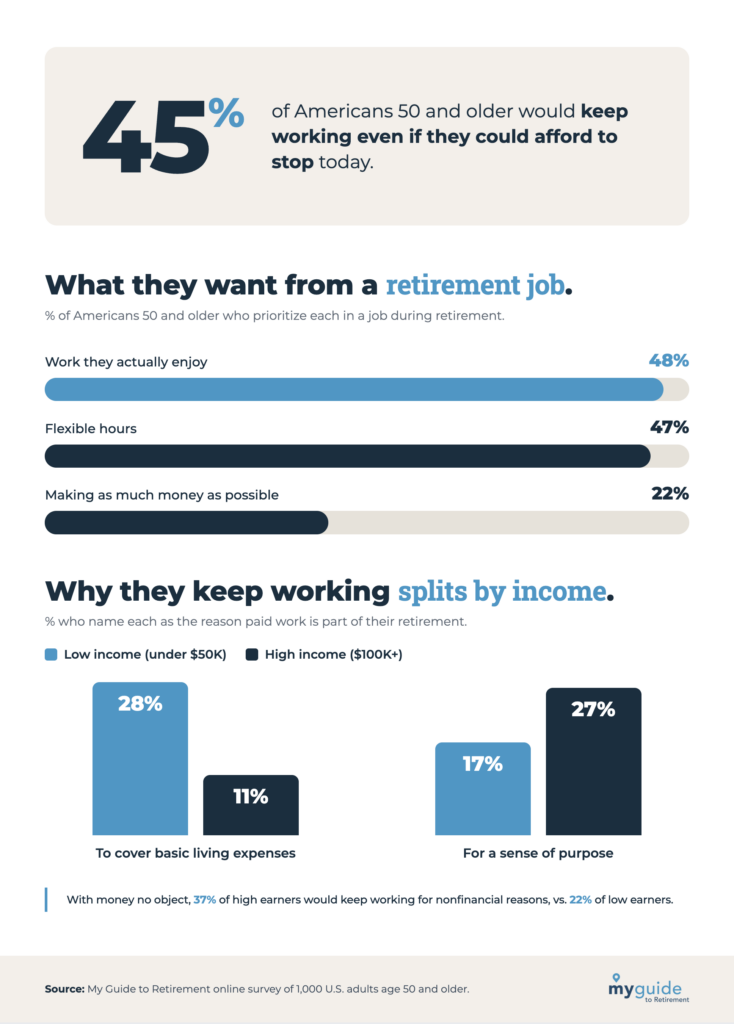
Plenty of respondents would keep working with no financial need at all. If they could afford to stop today and still live comfortably, 45% would keep working anyway, including 27% who would stay for nonfinancial reasons like enjoyment or social connection. When asked why paid work is part of their retirement, respondents most often cite staying mentally or physically active (23%), just ahead of covering basic living expenses (21%). Many respondents see work as a way to stay healthy and engaged, and they rank that benefit right alongside paying the bills.
People at every income level answer the stop-or-stay question almost identically, as low earners (42%) and high earners (44%) are nearly equally likely to say they’d quit completely if money weren’t a concern. Their motives for staying split sharply, though. Low earners most often keep working to cover basic living expenses (28%, compared with 11% of high earners), while high earners most often cite a sense of purpose (27%, compared with 17% of low earners). Even with money being no object, 37% of high earners would keep working for nonfinancial reasons, compared with 22% of low earners, who have fewer income options in retirement and still treat a job as a lifeline.
Respondents also know what they want from a retirement job, and top pay isn’t high on the list. They most often want work they actually enjoy (48%) and flexible hours (47%), while 22% prioritize making as much money as possible. Low earners put more weight on pay (25%, compared with 16% of high earners), and women are more likely than men to prioritize working from home (25% vs. 18%). A 67-year-old with a bad knee or a spouse to care for may only be able to keep working the job that comes to them.
Middle Class Is the Least Likely to Ever Retire
Most people assume Americans with the least money face the longest road to retirement. In many ways, they do. Yet households in the middle of the income ladder carry a different kind of pressure, and they rarely show up in the conversations about who is falling behind. Many of them now expect to stay on the job longer after peers on either side have stopped.
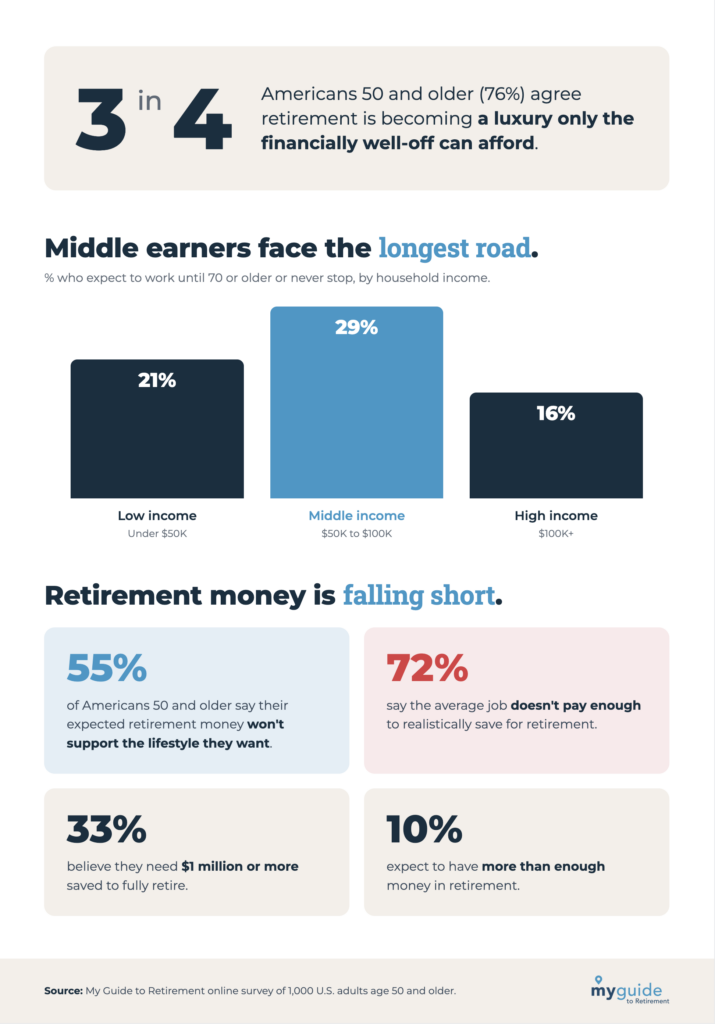
Respondents across income levels worry they’ll come up short. Among those surveyed, 55% say the money they expect to have in retirement won’t support the lifestyle they want, and only 10% expect to have more than enough. Many set a high bar for comfort, with 33% believing they need $1 million or more saved to fully retire and 9% saying no amount would make them feel completely secure. Women feel the gap more acutely, as 59% say their money won’t support the life they want, compared with 51% of men.
Middle earners face the longest working horizon of any income group. They’re the most likely to say they’ll never fully stop working for pay (12%, compared with 8% of low earners and 3% of high earners), and 29% expect to work until 70 or older or never stop, compared with 21% of low earners and 16% of high earners. Many middle-income households earn too much to qualify for programs that support lower earners but not enough to build the cushion that lets higher earners step away. Respondents overall share their frustration: 76% agree retirement is becoming a luxury only financially well-off Americans can afford, and 72% say the average job doesn’t pay enough to realistically save for it.
Respondents see health care as the biggest threat to retiring or staying retired, with 27% naming either a major medical expense or the need for long-term care, costs that make choosing the right health coverage after retirement a core part of any plan. More respondents name a reduction in Social Security benefits than any other single threat (15%). Low earners, who often rely more heavily on Social Security, are three times as likely as high earners to name benefit cuts as their biggest threat (24% vs. 8%), while high earners are nearly six times as likely to name a major stock market decline (14% vs. 2%). Each group fears losing whatever its retirement depends on most.
The Hidden Cost of Retirement Anxiety
Americans worried about retirement rarely talk about the pressure openly. They quietly buy fewer groceries and push the dentist appointment into next year. Some go further, making choices they’d rather keep hidden even from the people closest to them.
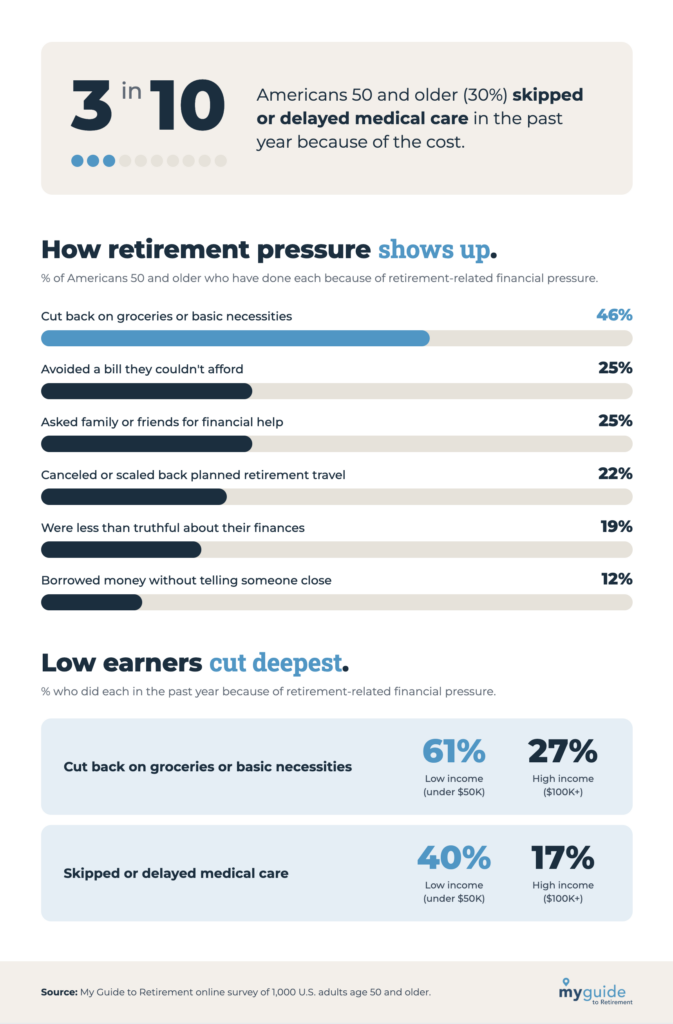
Respondents have already started trimming the retirement they once pictured. Among them, 22% have canceled or scaled back travel they planned for retirement, and 20% have changed the retirement lifestyle they once imagined because they can no longer afford it. Others are shrinking what they hope to pass on, as 14% have reduced how much they expect to leave their family as an inheritance. Adult children counting on help to build generational wealth may feel those cuts years from now.
Closer to home, 46% of respondents cut back on groceries or basic necessities in the past year because of retirement-related financial pressure, and 30% skipped or delayed medical care because of the cost. Women made grocery cuts more often than men. (53% vs. 40%), as did 61% of low earners, though 27% of high earners trimmed their grocery spending, too. Low earners skipped or delayed medical care at more than twice the rate of high earners (40% vs. 17%), a trade-off that can turn a manageable health problem into a costly one. A quarter of respondents (25%) avoided a bill they couldn’t afford, and the same share asked family or friends for financial help.
Many who responded also kept their struggles private, as 19% lied or were less than truthful about their financial situation and 12% borrowed money without telling someone close to them. A smaller share went further, with 8% admitting to taking something from a store without paying. Men (10%) are more likely than women (6%) to say so, and low earners are more than twice as likely as high earners to have done it (12% vs. 5%). Behind each of those answers is someone who likely tried quieter cutbacks first and found they weren’t enough.
Finfluencers, AI, and Planning a Retirement That Works
Americans used to get bad financial advice from a pushy salesperson or a well-meaning brother-in-law. Today they scroll past it in their feeds, delivered with total confidence by strangers they’ve never met. Older adults aren’t immune to the pitch. Many also worry about a newer force that could cut their working years short.
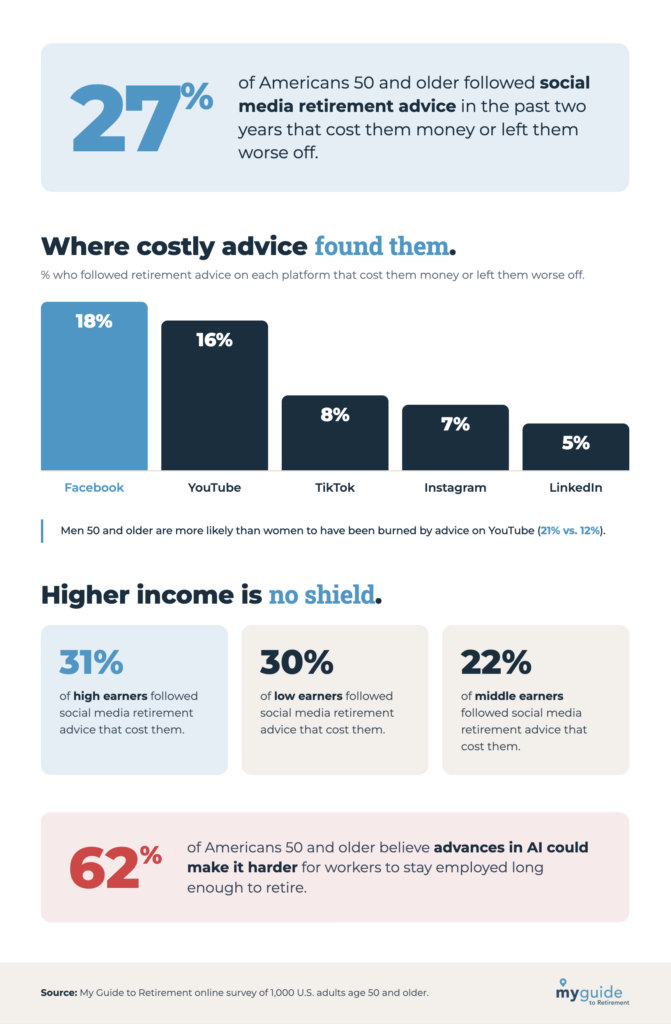
Older adults get burned online, too. More than 1 in 4 respondents (27%) followed retirement advice on social media in the past two years that cost them money or left them worse off. Respondents most often got burned on Facebook (18%), and YouTube (16%), followed by TikTok (8%), Instagram (7%) and LinkedIn (5%), likely because people 50 and older run into bad advice where they already spend their time online. Men are more likely than women to have been burned by advice on YouTube (21% vs. 12%).
Wealthier respondents prove just as vulnerable. High earners (31%) and low earners (30%) were burned at nearly the same rate, while middle earners reported it less often (22%). They just get burned in different places, as low earners are more than twice as likely as high earners to have been burned on TikTok (12% vs. 5%) and high earners are three times as likely as low earners to have been burned on LinkedIn (9% vs. 3%). Influencers likely tailor their pitch to the audience in front of them, from quick-money tips on TikTok to polished investigative talk on LinkedIn.
Respondents also see a newer threat to their working years, as 62% believe advances in AI could make it harder for workers to stay employed long enough to reach retirement. People counting on a few extra working years to close a savings gap have good reason to take that worry seriously. Even so, 85% say there’s no single “right” age to retire, including 91% of high earners and 80% of low earners. Respondents who want to choose that age for themselves will need a plan built on trustworthy guidance rather than whatever their feed serves up next.
How to Build a Retirement on Your Own Terms
Americans approaching retirement no longer follow one script, and they know it. Some will keep working by choice and others out of necessity, often shifting between the two as their health and savings change. People facing that uncertainty need a plan flexible enough to survive it.
Retirees and near-retirees can start by stress-testing their retirement budget against rising prices and an unexpected health setback, then treating any paid work as a bridge rather than a guarantee. Before acting on advice from a feed, anyone can check whether the source holds a professional license and stands to profit from the recommendation. Couples who talk openly about money now may spare themselves the financial secrets that so often follow a squeeze.
Americans may never again get the tidy retirement their parents planned around. Those who plan early and adjust as they go can still build one that fits the life they want, with or without a paycheck in it.
Methodology
My Guide to Retirement surveyed 1,000 U.S. adults age 50 and older through an online Pollfish survey. The survey examined Americans’ retirement plans and timelines, the role of paid work in retirement, financial readiness, perceived threats to retirement, financial strain tied to retirement pressure, and experiences with social media retirement advice. Results were analyzed by gender and household income. Low income defined as annual household earnings of below $50k. Middle income defined as annual household earnings of $50k to $100k. High income defined as annual household earnings above $100k. Results were post-stratified. Percentages may sum to more than 100% where respondents could select multiple answers.
About My Guide to Retirement
My Guide to Retirement offers free planning guides and expert insights to help Americans prepare for a healthier, wealthier retirement. Its resources cover everything from Medicare coverage to estate planning, helping readers balance physical well-being with financial security. As more Americans build paid work into their later years, My Guide to Retirement helps them plan a retirement that fits their own goals and timeline.
Fair Use Statement
The findings in this research may be shared for noncommercial purposes only. Anyone who references or republishes this content should credit My Guide to Retirement and include a link to the original research.
Start Planning Today for a Secure and Healthy Retirement
Use the free tools and resources at My Guide To Retirement to plan a comfortable and fulfilling retirement, according to your specific financial and health goals.
